/
KBO MCP: Belgian company data, financial statements, and the Official Gazette in Claude, ChatGPT, and Copilot
KAI BUSINESS DATA
KBO MCP: Belgian company data, financial statements, and the Official Gazette in Claude, ChatGPT, and Copilot
Who are the biggest employers in Flanders? Which construction companies in Limburg got a new director this year? Where does my company rank in my town? With our KBO MCP, you just ask your AI assistant questions like these, whether that's Claude, ChatGPT, or Microsoft Copilot. The answers come straight from the official sources: the KBO (the Belgian company register), the Belgian Official Gazette, and the financial statements filed with the National Bank of Belgium.

updated on
7 October 2026
On this page
▾


What would you ask?
Give us your own company, your street, or your town, and in a short call we'll show you what Kai Business Data knows about it, using the questions you want to ask.
Book an intro callIn short
Kai Business Data brings the KBO (the Belgian company register), the Belgian Official Gazette, and the National Bank's financial statements together in one database. Through MCP, your AI assistant can access it directly.
It works in Claude by Anthropic, ChatGPT by OpenAI, and Microsoft Copilot.
You're not stuck with a search box. You ask open-ended questions and combine criteria from all three sources, for all of Belgium and down to street level.
You don't need the exact name. Without accents, with a typo, or through a trade name, you'll still find the right company.
If the KBO has no website, phone number, or email address, we fill it in, always with the source listed.
The data goes straight into your CRM: into Dynamics 365 or Power Apps through our Dataverse MCP, but just as easily into Teamleader, Odoo, HubSpot, Salesforce, or another package.
What is a KBO MCP?
The Crossroads Bank for Enterprises, known in Belgium as the KBO, is the official register of every Belgian company. Today, people who use that data usually go to the KBO website, look up one company, and copy whatever they need into their CRM or a spreadsheet.
MCP, short for Model Context Protocol, is the standard that lets an AI assistant talk to an external data source. Think of it as a plug: the assistant knows what it can ask the source and gets the answers back directly.
So a KBO MCP is the connection between your AI assistant and company data. We built that connection and call it Kai Business Data. You ask your question in plain language and the assistant looks up the answer, without you ever leaving the conversation.
Three sources in one database
Looking up one company is one thing. Asking a question about thousands of companies at once is something else. For that, all the data has to be in one place, and that's exactly what Kai Business Data does.
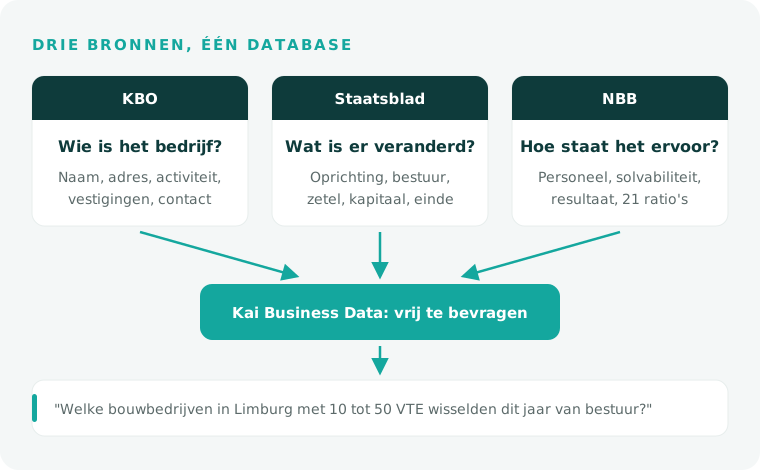
The KBO tells you who a company is: every active Belgian company and its locations, with name, trade names, address, legal form, start date, activities with their NACE code, and contact details. Together, that's nearly two million companies and 1.7 million locations.
The Belgian Official Gazette tells you what has changed: incorporations, changes in directors, moves of the registered office, capital changes, mergers, dissolutions, and court decisions.
The financial statements filed with the National Bank show how a company is doing: headcount in full-time equivalents, equity, profit or loss, and the 21 ratios the National Bank calculates itself, such as solvency and liquidity.
We update the data from all three sources every day. So a new publication in the Official Gazette or a newly filed set of financial statements shows up quickly.
A question, not a search box
Most company databases work with a search box. You enter a name or a company number and get that one company back, or you pick from lists the provider has put together in advance. Most other MCPs for company data work the same way: one company per question.
Kai Business Data works differently. The assistant can ask open-ended questions about the entire database. It filters, counts, compares, and ranks on any combination of criteria, across all three sources. Nobody has to have thought of your question ahead of time.
You only notice that difference when you try it yourself. Below are three questions we asked the assistant in October 2026. Each time, we had the answer within seconds.
The biggest employers in Flanders
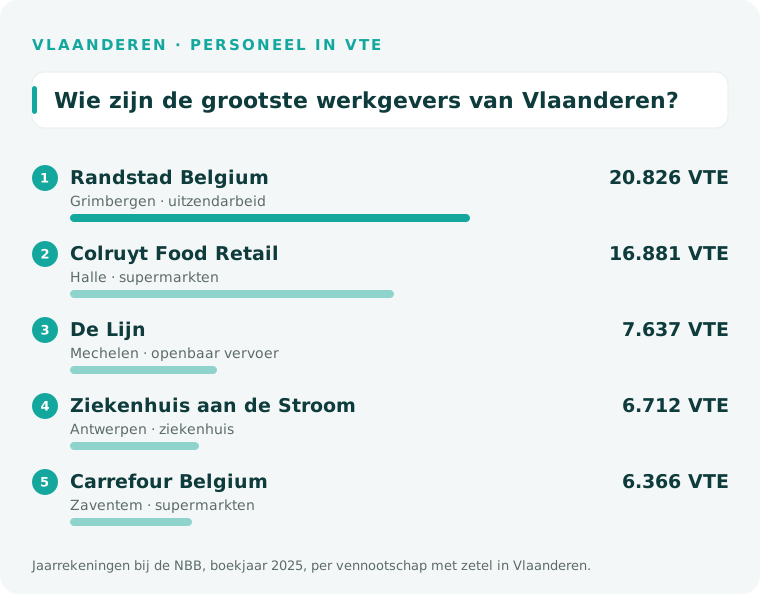
The list ranks companies with their registered office in Flanders by their average headcount in full-time equivalents, as they report it in their own financial statements. A group like Colruyt is made up of several companies, and each one counts separately. And a company with its registered office in Brussels isn't included, even if many of its people work in Flanders.
Where do the most people work in Ghent's restaurant scene?
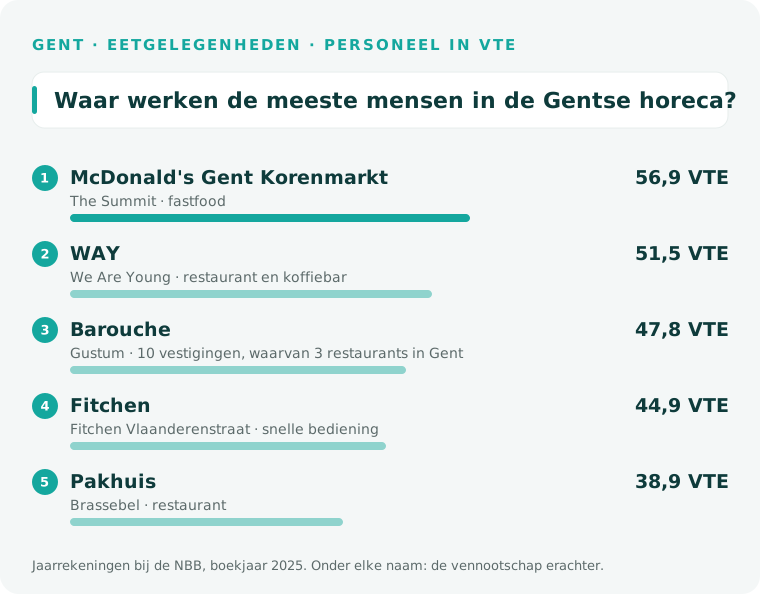
This shows why trade names matter. The financial statements list The Summit, We Are Young, and Brassebel. In Ghent, everyone knows them as McDonald's Korenmarkt, WAY, and Pakhuis. With only the official names, a list like this means nothing to the reader.
And you can follow up right away. Of the 714 restaurant and hospitality companies in Ghent with financial statements for 2025, 222 closed the fiscal year at a loss. That's almost one in three.
The most solvent employers in Limburg
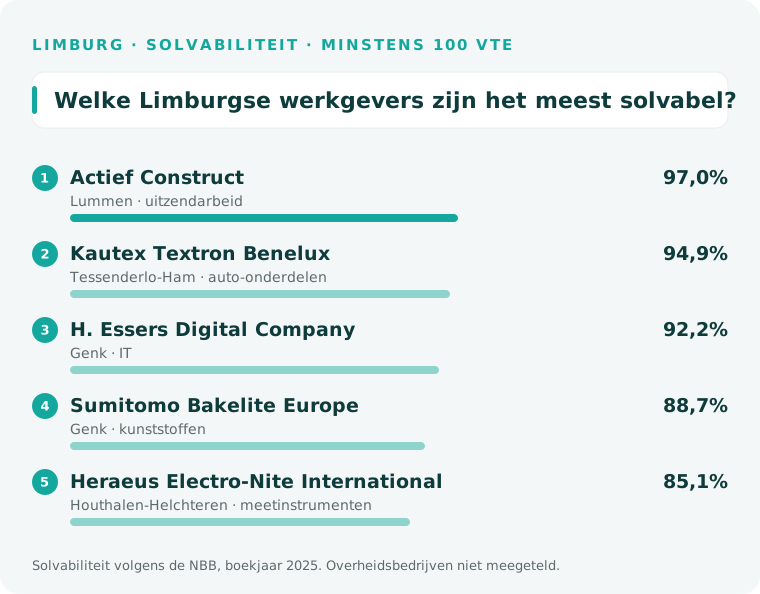
Solvency is the share of the balance sheet financed with the company's own funds. The higher it is, the less a company depends on banks and suppliers. We only included companies with at least 100 FTEs, because otherwise small holding companies dominate the top of the list. We left out government-owned companies. You make choices like these yourself, right in your question.
What has changed: the Official Gazette as a timeline
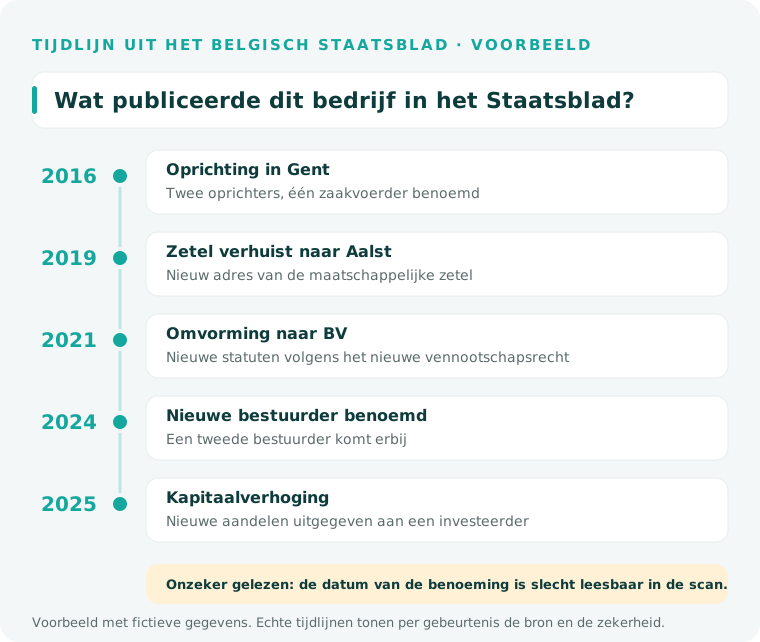
You read financial statements once a year. A publication in the Official Gazette tells you what just changed: a new director, a move, a capital increase. That's often exactly the right moment to reach out.
Those publications are scanned PDFs. Kai Business Data reads them and puts the events on a timeline, each one linked to the publication it came from. Anything that can't be read with certainty is shown separately, so you know what's worth double-checking. Here's what a timeline like that looks like, using fictional sample data:
What you can ask
Here's a set of questions the way a salesperson, an account manager, or a business owner would ask them. You type them in plain language, and the assistant turns them into the right lookup.
Getting to know one company
Give me everything you know about the company with company number 0534.390.321.
I'm on Europalaan in Genk. Which companies have a location here, and which one has the most staff?
How is this company doing: headcount, equity, profit or loss, and solvency, compared to the year before?
Put this company's publications in the Official Gazette on a timeline.
I have a business card from McDonald's Gent. Which company is behind it?
What locations does this company have, and what does each one do?
Finding prospects
Make a list of installation companies in East Flanders with 10 to 50 FTEs, a profit in the last fiscal year, and solvency above 30%.
Which bakeries in Antwerp aren't customers of ours yet?
Which IT companies with more than 20 FTEs don't we have a website for?
Which construction companies were founded in Limburg in the last three months?
Which companies moved their registered office to Limburg in the last three months?
Which IT companies grew their headcount compared to the year before?
Make a list of prospects for our booth at the trade show in October and tag them as “prospect trade show October.”
Add the first ten from that list as leads in HubSpot, with their company number and address.
Keeping tabs on your customers
Which of our customers published a change in directors in the Official Gazette over the past year?
Which of our customers have solvency below 15%?
Which court decisions were published for companies in East Flanders in the last two weeks?
Which customers in our CRM still have an old address?
Knowing your market and your region
Who are the biggest employers in my town?
Where does my company rank in Aalst by number of employees?
How many restaurants and bars in Ghent posted a loss in the last fiscal year?
How many companies are there in postal code 3600, by industry?
Which construction companies in Limburg with 10 to 50 FTEs changed directors this year?
A question doesn't have to be perfect the first time. You build on the previous answer: “now only the ones with their own website,” “sort them by headcount,” “which of those are already customers?” The assistant remembers what you're working on.
You don't need the exact name
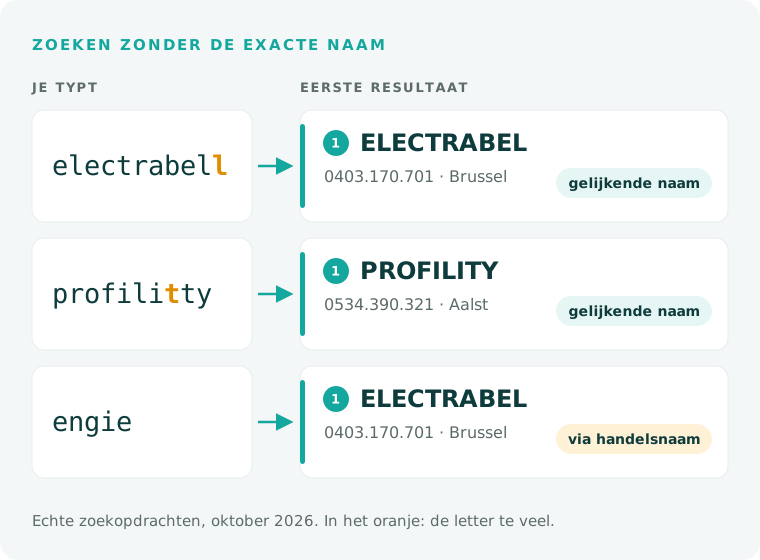
When people copy a company name from an email or a business card, they rarely type it perfectly. The search takes that into account.
You can type accents or leave them out: Société and societe give the same result. One letter too many or too few usually still finds the right company. Search for electrabell and Electrabel comes up first. Search for profilitty and you'll find us. The assistant always mentions that it's a similar name and not an exact match, so you know to double-check.
And a trade name takes you to the company behind it: search for Engie, and you'll find Electrabel.
Where the sources fall silent or get it wrong
The KBO knows a lot about who a company is, but much less about how to reach it. Only 1 in 40 active companies has a website listed in the KBO, and fewer than 1 in 7 has an email address.
So we fill in the gaps. When we find a website, phone number, email address, or LinkedIn page, we store it with the company, noting that the data comes from Profility and where we found it. The KBO's own data stays unchanged. So you can always see what's official and what was added.
The sources themselves aren't flawless either. There's sometimes a difference between the financial statements a company files and the figures the National Bank makes available from them. For example, we found a restaurant in Ghent that, according to those figures, has 151,025 full-time employees. That's impossible. When we find a number that can't be right, we use our own formula to make a well-founded estimate, based on what similar companies in the same industry and the same region report. We left figures like that out of the lists in this article.
You can also tag companies yourself. A tag like “customer,” “prospect,” or “trade show October” shows up in every lookup, and you can use it in any question. You decide whether a tag applies to your whole organization or just to you, and nobody outside your organization can see it.
In practice
A lead that fills itself in
Someone fills out the contact form on your website. The lead lands in your CRM, and an agent immediately looks up the company based on the company name and town. It fills in the official name, company number, address, and activity, and adds the headcount and solvency from the latest financial statements. If it finds several companies with a similar name, it notes the candidates and lets the salesperson choose. We build an agent like that for you, on top of Kai Business Data and your own CRM.
Creating a new customer from a single number
In the conversation, you ask to create an account for a company number. The assistant pulls the data and creates the account in your CRM, with the official name, address, and legal form. No retyping and no typos.
Cleaning up your customer database
After a few years, some of your customer data is no longer accurate. Have the assistant compare your accounts against the KBO and the Official Gazette, and you'll get a list of what doesn't match: a different address, a different name, a new director, or a company that's no longer active. You decide what gets updated. To learn how to avoid errors like these from the start, read our article on what a customer management system should be able to do.
A real estate portfolio with verified owners
For a client in the real estate industry, we imported their entire property portfolio into the CRM. Every property owner was checked against the KBO along the way. For existing accounts, the address had sometimes changed, and that was corrected right away. Unknown owners were created with their official details. After the import, the CRM wasn't just full of properties. The customer data had been cleaned up too.
Works in Claude, ChatGPT, and Microsoft Copilot
Kai Business Data works in any AI assistant that supports MCP:
Claude by Anthropic, which we use every day ourselves;
ChatGPT by OpenAI;
Microsoft Copilot, so you can pull up KBO data, financial statements, and Official Gazette publications in the environment your organization already works in.
You ask the same questions everywhere and get the same data everywhere.
Together with our Dataverse MCP and Dynamics 365 MCP
If you want to do more than look up the data and actually get it into your CRM, Kai for Dataverse comes into play. That's our Dataverse MCP, which also makes it a Dynamics 365 MCP, because Dynamics 365 and Power Apps both run on Dataverse. In the same conversation, the assistant looks up a company and puts it in your CRM: creating an account, correcting an address, enriching a lead with figures from the financial statements.
Kai for Dataverse works with your own permissions. Whatever you're not allowed to do in the application yourself, the assistant can't do either.
Also works with Teamleader, Odoo, HubSpot, Salesforce, and other CRMs
Kai Business Data isn't tied to Microsoft. The company data reaches your AI assistant through MCP, and in the same conversation that assistant also talks to your CRM, whatever software it is.
If you use Teamleader, Odoo, HubSpot, Salesforce, Pipedrive, or monday.com, you connect your assistant to your CRM and add Kai Business Data alongside it. More and more CRM vendors offer their own MCP connector for this. Where that's not the case yet, we build the integration.
After that, it works as described above:
put together a prospect list and add the companies to your CRM as leads right away;
enrich an account with the company number, the activity, and the figures from the financial statements;
compare your customer database with the KBO and the Official Gazette and see what's no longer accurate.
Your CRM stays the place where you work. Kai Business Data makes sure the company data in it is correct. Still not sure which software fits you? Read how to choose a CRM as an SME.
What would you ask?
Give us your own company, your street, or your town, and in a short call we'll show you what Kai Business Data knows about it, using the questions you want to ask.
Book an intro callThis article is part of
AI and Agents
Put AI to work for you: a digital coworker that carries out tasks in your Microsoft apps, follows up, and talks to your data.
Explore AI and AgentsKeep reading
CRM AND ERP
A CRM alongside your ERP: why you don't have to keep track of anything twice
You've been working in an ERP like Business Central for years. Adding a CRM sounds like a second system where you keep track of everything twice. It doesn't have to be: agree on which system manages each piece of data, and each system does its own part.
AI IN PRACTICE
Beyond digitization: working with an AI assistant on top of your business Applications
A customer email comes in. Five minutes later, the project is set up in Connect, our in-house application, and colleagues can log hours on it. Add the tasks in Jira and it takes fifteen minutes. Meanwhile, I was drinking my coffee. That's how we've been working at Profility for a year now. This is the step after digitization.
AI IN PRACTICE
Every application you commission today needs an MCP
If you're having an application built today, whether fully custom or on the Power Platform, there's one question many clients still don't ask: does it have an MCP? Without one, an AI agent can't work for you inside that application. If you want to build for the future, it's non-negotiable.